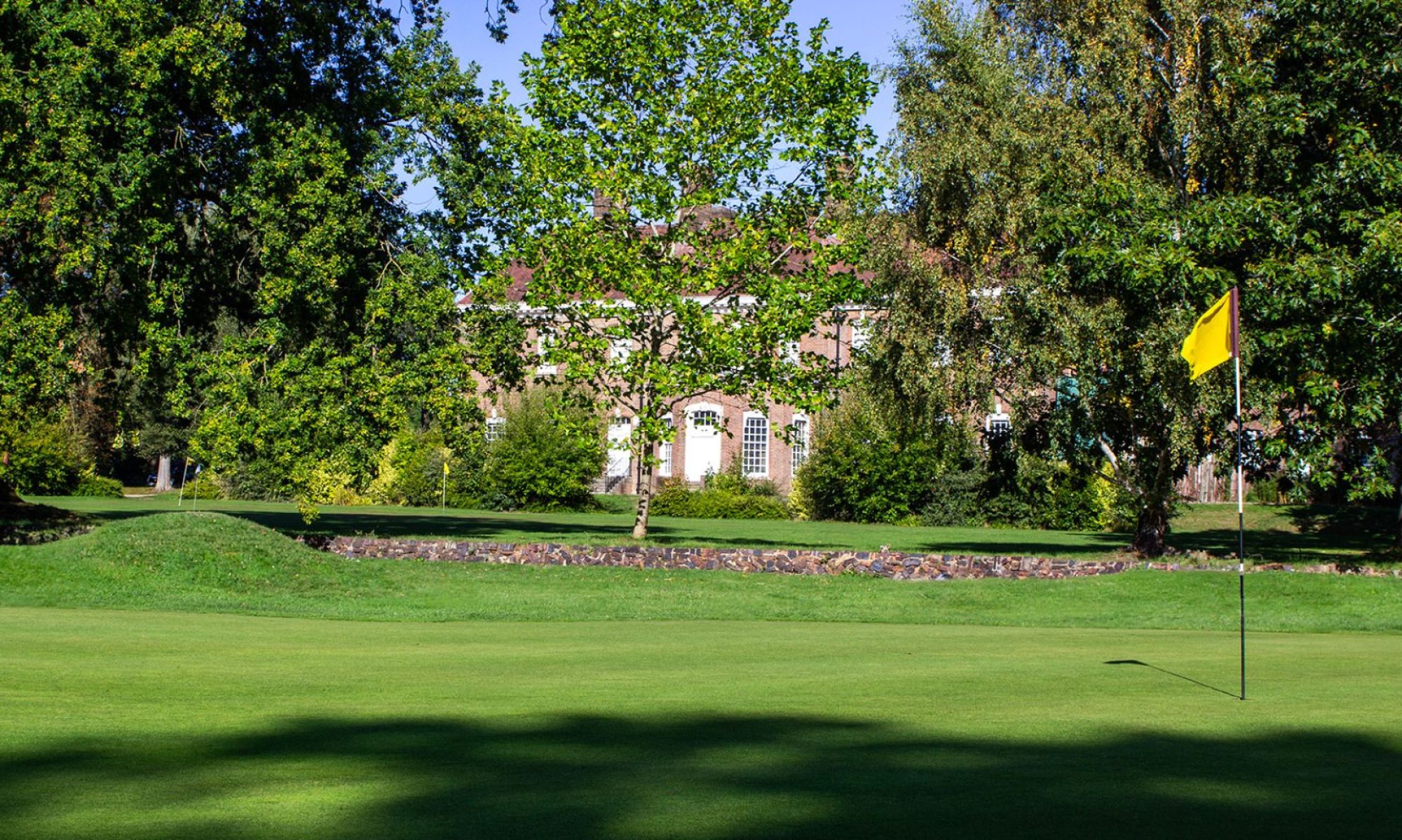
A Brief History of Batchwood Hall
The Batchwood estate was acquired from the Gorhambury estate by Edmund Beckett Denison in 1874.
Denison was a man of many talents — a Cambridge mathematician, barrister, architect, horologist
and later a peer of the realm. His passion for architecture, particularly ecclesiastical buildings,
led him to acquire the Batchwood estate and build Batchwood Hall as his private residence.
Denison graduated 30th in the Mathematical Tripos at Cambridge and was called to the Bar in 1842.
His great interests were horology and architecture. He became president of the British Horological Institute in 1868.
It was his architectural interests that drew him to St Albans, where he controversially oversaw restoration works
on St Albans Abbey, St Michael’s Church and St Peter’s Church.
Batchwood Hall, built in the Queen Anne style and complete with a clock tower, offered a commanding view of the Abbey.
It is said that Edmund was able to watch the restoration work through a spy glass from the Hall.
In the same year he acquired the estate, 1874, Edmund succeeded his father in the Baronetcy and, like his father before him,
dropped the surname Denison, calling himself Sir Edmund Beckett.
The rebuilding project at St Albans Abbey was directed by Edmund and undertaken at his own cost.
Though he saved the Abbey from collapse, his work was not universally admired.
He even gave a verb to the English language — “to Grimthorpe”, meaning to lavishly over‑restore without regard to taste.
Did You Know?
Sir Edmund Beckett designed the escapement mechanism used in the Great Clock at Westminster —
the clock that drives ‘Big Ben’. The clock in the tower of Batchwood Hall is a miniature version
of the Westminster design.
With his clockmaker expertise, Sir Edmund played a major role in the design of the Great Clock at Westminster.
His double three‑legged gravity escapement became the standard for turret clocks after 1859.
For his services to the Church, particularly in legal matters, Sir Edmund was raised to the peerage in 1886,
becoming the first Baron Grimthorpe. He died in 1905 and is buried in St Albans Abbey.
Historical Timeline
- 1874: Batchwood estate acquired; Batchwood Hall constructed.
- 1874: Succeeds to the Baronetcy and becomes Sir Edmund Beckett.
- 1868–1886: Major involvement in horology and church restoration.
- 1859: Designs the escapement for the Great Clock at Westminster.
- 1886: Raised to the peerage as Baron Grimthorpe.
- 1905: Dies and is buried in St Albans Abbey.
A Legacy That Lives On
Today, Batchwood Hall Golf Club proudly occupies the grounds of this historic estate.
The Hall’s architectural heritage, its connection to St Albans Abbey, and its link to the
world‑famous Westminster clock all contribute to the unique character of the club.